Why Drinking Coffee the Moment You Wake Up Works Against Your Own Cortisol Rhythm
Quick Answer: Your body produces its own cortisol spike in the 30–45 minutes after you wake up — that’s the cortisol awakening response, and it’s already making you alert. Drinking coffee inside that window stacks caffeine on top of a peak you didn’t need help with. Waiting roughly 60–90 minutes lets the natural peak fade first, so caffeine fills the dip instead of competing with the surge.
Alarm. Feet on floor. Coffee maker. That sequence feels non-negotiable, and for most people it’s been the same for a decade.
Here’s the awkward part: in that specific window, your body is already doing the exact thing you’re asking the coffee to do.

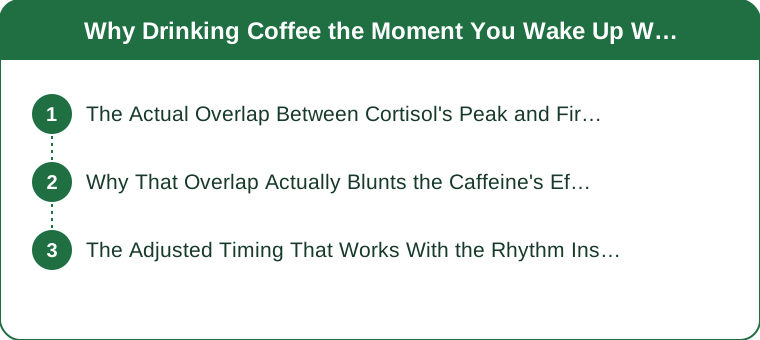
What Is the Cortisol Awakening Response?
It’s a sharp, predictable rise in cortisol that happens automatically in the 30 to 45 minutes after you open your eyes — no caffeine, no alarm, no cold shower required.
Cortisol has a bad reputation as “the stress hormone,” but in the morning it’s doing something useful: raising blood sugar, sharpening alertness, and switching your nervous system from sleep mode to awake mode. It’s your built-in ignition.
The response typically peaks somewhere around 30 to 45 minutes post-waking and then starts declining through the rest of the morning. Which means the moment most people reach for their first cup is almost exactly the moment their own system is already running at its morning maximum.
The reframe worth sitting with: that first-thing window is the one time of day caffeine isn’t filling a gap. It’s piling onto a peak that was handling itself.

Does Drinking Coffee Right After Waking Blunt Its Effect?
Over time, plausibly yes — and the mechanism is tolerance, not magic.
Caffeine works by blocking adenosine receptors. Use it consistently at the same time every day and your body adapts by adding more receptors, so the same dose does less. That’s ordinary caffeine tolerance and it’s well established.
What the timing argument adds is this: if you’re routinely stacking caffeine onto an already-elevated alertness state, you’re spending your caffeine at the hour when you needed it least — and building tolerance specifically at that hour. Six months later the 7 a.m. cup does almost nothing, and the fix people reach for is a bigger cup rather than a later one.
An honest caveat: the “delay your coffee” advice is popular, and the underlying biology (the cortisol awakening response, caffeine tolerance) is solid. But direct human trials proving that a 90-minute delay measurably improves alertness or reduces tolerance are limited. Treat this as a reasonable, zero-cost experiment rather than settled science.
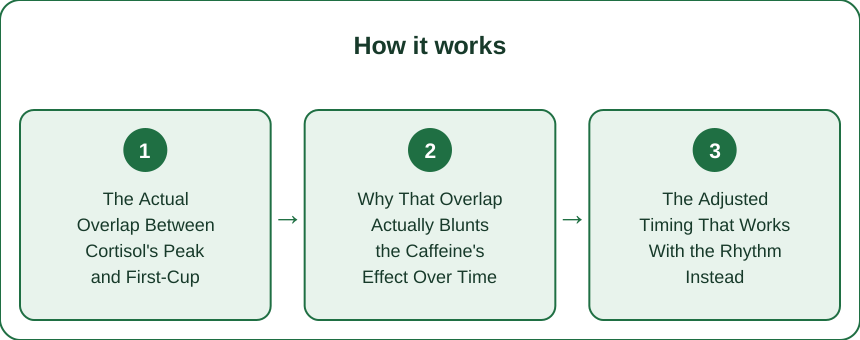
What Nobody Tells You About Coffee Timing
- The afternoon cutoff matters more than the morning delay. Caffeine’s half-life is roughly 5–6 hours, meaning a 4 p.m. cup still has about half its caffeine in you at 10 p.m. If you only change one thing, change that one. Poor sleep raises next-morning cortisol, which is how the cycle feeds itself.
- Your peak isn’t clock-based, it’s wake-based. If you get up at 5:30, your window is roughly 6:00–6:15. If you sleep in on Saturday until 9, it shifts with you. “Wait until 9 a.m.” is meaningless advice; “wait an hour after waking” isn’t.
- Light does more than you think. Ten minutes of daylight shortly after waking supports the cortisol rhythm directly. It also makes the delay easier, because you’re doing something instead of staring at the kettle.
- The delay is hardest for three days. After that, most people stop noticing. If you can’t face it cold, move the first cup back 15 minutes a week.
- Decaf and tea aren’t loopholes if it’s the ritual you want. If you genuinely just like holding a warm mug at 6 a.m., hold one. Water, herbal tea, or decaf preserves the ritual and moves the caffeine.
How Long Should You Wait to Drink Coffee After Waking?
Roughly 60 to 90 minutes. That’s long enough for the cortisol awakening response to have peaked and started declining, so caffeine layers onto a falling curve rather than a rising one.
What that looks like in practice:
- Wake up. Water first — you’re mildly dehydrated after 7 hours without fluid, and some of that morning fog is just that.
- Get light on your face within the first 30 minutes if you can. Outside beats a window; a window beats nothing.
- Move a little. A walk, a shower, breakfast — anything that isn’t waiting for the timer.
- First cup at the 60–90 minute mark. Now you’re extending alertness into the natural post-peak dip instead of competing with the surge.
- Last cup 8–10 hours before bed. For an 11 p.m. bedtime, that’s a hard stop around 1–3 p.m.
If you take medication in the morning, or you’ve been told to manage blood pressure, blood sugar, or anxiety, check with your doctor before changing caffeine habits — caffeine interacts with more prescriptions than most people realize.
When to see a professional: if you’re exhausted every morning despite adequate sleep, if you need caffeine to function at a basic level, or if you have persistent sleep problems, jitteriness, or heart palpitations, that’s worth a conversation with a doctor rather than a timing tweak. Chronically disrupted cortisol can point to thyroid, sleep, or adrenal issues that no coffee schedule will fix.
FAQ
Is it bad to drink coffee immediately after waking up?
Not harmful, just inefficient. Your cortisol awakening response is already producing alertness in that window, so the caffeine has less to add — and daily use at that hour is where tolerance builds fastest. Delaying costs nothing and is worth testing for two weeks.
How long does the cortisol awakening response last?
It rises immediately on waking, peaks around 30–45 minutes after, then declines gradually over the following hours. It’s tied to when you wake, not to a fixed time on the clock.
Will delaying my coffee actually give me more energy?
Some people report a noticeably stronger effect from the same amount of coffee within a couple of weeks. Others notice nothing. Since the experiment is free and reversible, two weeks of data on yourself beats any general claim.
TL;DR
- Cortisol peaks naturally 30–45 minutes after waking — you’re already alert without coffee.
- Drinking coffee inside that window stacks caffeine on an existing peak instead of filling a gap.
- Daily stacking is where tolerance at that specific hour builds.
- Wait roughly 60–90 minutes so caffeine lands on the post-peak dip.
- Water and morning daylight first; last cup 8–10 hours before bed.
- The evidence for the mechanism is solid; the evidence for the exact 90-minute number is thin. Test it on yourself.
Keep Reading
This article is for general informational purposes only and is not medical advice. Always consult a qualified health professional for guidance specific to you.