Cortisol and Darker Mornings: Your Questions, Answered
Quick Answer: The cortisol awakening response is a sharp rise in cortisol in the first 30 to 45 minutes after waking, and it helps you transition into alertness. It is influenced by light exposure and by circadian timing, both of which shift as sunrise moves later in autumn. Waking in darkness tends to produce a less pronounced transition into alertness, which is why mornings feel heavier. Getting bright light early is the practical lever - and it matters more than anything you could take.
This is general information rather than medical advice.

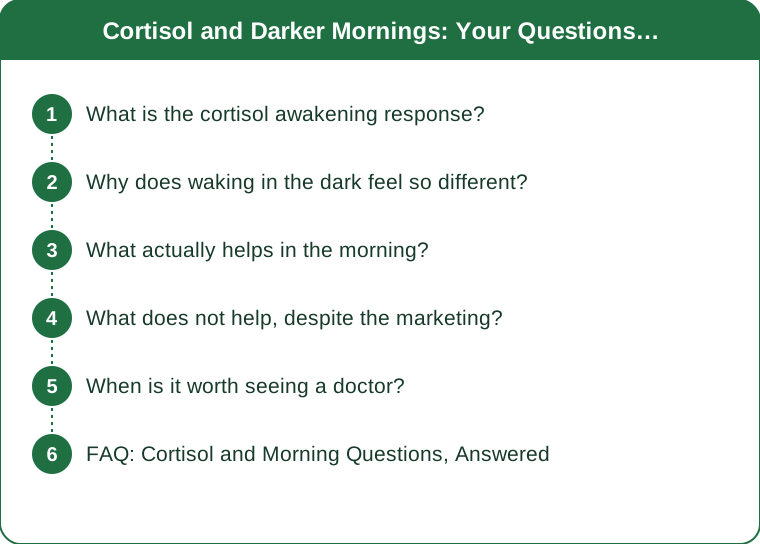
What is the cortisol awakening response?
A sharp, normal rise in cortisol shortly after you wake
Cortisol follows a daily rhythm - lowest around the middle of the night, rising toward morning, peaking shortly after waking, and declining across the day. On top of that underlying rhythm sits a distinct spike in the 30 to 45 minutes after waking, commonly called the cortisol awakening response.
Is it a bad thing?
No. This is one of the most persistent misunderstandings about cortisol. A healthy awakening response is a sign of a functioning stress and circadian system, not a problem. It mobilises energy, raises alertness, and supports the transition from sleep to being awake.
Cortisol has been marketed as a villain, and it is a normal and essential hormone. The interesting questions are about timing and pattern, not about whether it is high or low in isolation.
What affects it?
- Light exposure at and after waking, which is the relevant one here
- Wake time, with earlier waking generally associated with a larger response
- Sleep quality and duration
- Anticipated demands of the day, which is a genuine and well-documented effect
- Chronic stress, which is associated with altered patterns in either direction
Why does this matter in autumn?
Because the light input that helps anchor the whole rhythm has moved later by well over an hour since midsummer, while most alarms have not.
Why does waking in the dark feel so different?
Light is the main signal that sets your body clock
Specialised cells in the retina detect light and signal the master clock in the hypothalamus, which in turn influences the timing of cortisol, melatonin, core temperature, and alertness. Morning light advances the clock; darkness at waking removes that input.
What changes as sunrise moves later
In mid-latitudes, sunrise shifts later by roughly a minute or two per day through late summer and autumn. By this point in the season, many people who woke into daylight in June are now waking well before sunrise.
Without that morning light signal:
- The circadian clock tends to drift later
- Melatonin, which promotes sleepiness, takes longer to clear
- The transition into alertness is less sharp
- You feel groggier for longer, even after adequate sleep
Is this the same as sleep inertia?
Related, and worth distinguishing. Sleep inertia is the grogginess in the first minutes to an hour after waking, and it is worse when you wake from deep sleep and when your circadian timing is misaligned. Darker mornings tend to worsen it because your clock has drifted later relative to your alarm - so the alarm is arriving at a less favourable point in your sleep cycle.
Does this mean my cortisol is broken?
Almost certainly not. It means the environmental signal that shapes the timing has moved. Nothing about you has changed - the sun is coming up later than it was eight weeks ago.
What actually helps in the morning?
Bright light, as early as possible
This is the highest-value intervention by a considerable margin.
- Ten to twenty minutes outdoors within 30 to 60 minutes of waking, even on an overcast day. Outdoor light on a grey morning is far brighter than any indoor lighting
- A 10,000 lux light therapy box if it is genuinely dark when you wake - used for 20 to 30 minutes shortly after waking, while you do something else
- A dawn simulator alarm, which brightens gradually before your alarm and which many people find makes waking noticeably easier
Indoor lighting is roughly two orders of magnitude too weak to substitute, which is why turning on the kitchen lights does not help.
Does exercise help?
Yes, in two ways. Movement raises alertness directly, and morning exercise outdoors combines light exposure with movement, which is why a short morning walk outperforms both individually.
Exercise does raise cortisol acutely, and that is a normal and appropriate response, not something to avoid. The idea that morning exercise dangerously stacks with the cortisol awakening response is not well supported for ordinary training.
What about coffee?
The advice to delay your first coffee by 60 to 90 minutes because it blunts the natural cortisol rise circulates widely and has a weaker evidence base than its popularity suggests. Many people report feeling better with a slight delay, and if you do, that is a perfectly good reason to do it. It is not an established physiological requirement.
More relevant: the caffeine cutoff at the other end of the day. As mornings get darker and sleep timing drifts, an afternoon coffee costs more sleep than it did in summer.
What about consistency?
A consistent wake time is one of the strongest anchors for the whole rhythm. A two-hour weekend lie-in produces a phase shift comparable to travelling across time zones, and Monday morning is when that is paid for.

What does not help, despite the marketing?
Cortisol-lowering supplements
A large category, and the framing is usually wrong. Cortisol is not something you generally want to lower in the morning - a healthy morning rise is the point.
Some adaptogens, ashwagandha in particular, have research suggesting effects on perceived stress and on cortisol measures in stressed populations. The studies are generally small, and the effects are modest. They are not a substitute for light exposure and sleep timing, and ashwagandha specifically has cautions around thyroid conditions, pregnancy, and some medications - worth discussing with a pharmacist or doctor.
Cortisol testing
Saliva and urine cortisol testing is heavily marketed direct to consumers. A single cortisol measurement is difficult to interpret without clinical context, because the value depends enormously on the exact time, on what happened in the preceding hour, and on individual variation.
Genuine clinical cortisol disorders - Cushing’s syndrome and adrenal insufficiency - exist, are relatively uncommon, and are diagnosed through specific clinical protocols rather than a consumer panel. Adrenal fatigue is not a recognised medical diagnosis, and the symptoms attributed to it overlap heavily with sleep disruption, iron deficiency, thyroid dysfunction, depression, and perimenopause - all of which are diagnosable and treatable.
Sleeping longer to fix it
Often unhelpful, because the problem is usually timing rather than duration. Eight hours at a misaligned phase can feel worse than seven at an aligned one. Fixing the morning light usually shifts bedtime earlier by itself, which is the more effective route.
Blue light filters on screens
Screen light intensity is far too low to move circadian timing meaningfully. Screens delay sleep by keeping you engaged, not through their light output - so the useful intervention is putting the phone down, not filtering it.
When is it worth seeing a doctor?
Symptoms that deserve a proper look
Most autumn morning heaviness is circadian and resolves with light and consistency. Some things do not.
- Persistent low mood, loss of interest, appetite change, or withdrawal through autumn and winter, which may indicate seasonal affective disorder - a genuine, common, and treatable condition. Light therapy, talking therapies, and in some cases medication are all established options
- Profound daytime sleepiness despite adequate sleep, particularly with snoring or gasping in sleep, which can indicate sleep apnoea. It is significantly underdiagnosed in women, partly because presentations differ from the stereotype
- Fatigue that does not respond to any sleep or light improvement, which is worth investigating. Iron studies including ferritin, thyroid function, and vitamin D are common and reasonable first checks
- Insomnia lasting more than a few weeks, for which cognitive behavioural therapy for insomnia is the recommended first-line treatment and outperforms medication long term
- Unexplained weight change, muscle weakness, easy bruising, or unusual fat distribution, which are among the features that would prompt actual investigation of cortisol disorders
- Dizziness on standing, salt craving, and profound fatigue with darkening of the skin, which can indicate adrenal insufficiency and needs medical assessment
What to bring to the appointment
A short written timeline - when it started, the pattern across the day and week, what has changed, and what you have already tried. Symptom timing plotted against the season is genuinely useful information and it is exactly the kind of pattern that gets lost in a ten-minute appointment.
The reassuring version
For most people, waking feeling heavier in September and October is the predictable result of sunrise moving over an hour later while the alarm stayed still. Ten to twenty minutes of morning light on most days, and a consistent wake time including weekends, resolves the majority of it within one to two weeks.
This is general information rather than medical advice.
FAQ: Cortisol and Morning Questions, Answered
Is a morning cortisol spike bad?
No - it is a normal and necessary part of waking up. A healthy awakening response supports the transition into alertness rather than indicating stress.
Why does waking feel harder now than in summer?
Sunrise has moved well over an hour later, so the light signal that anchored your rhythm now arrives after your alarm. Your clock drifts later while your schedule stays fixed.
Should I delay my morning coffee?
The evidence for the cortisol-based reasoning is weaker than its popularity suggests. If a delay makes you feel better, that is reason enough - it is not a physiological requirement.
Do cortisol supplements work?
Some adaptogens have modest evidence in stressed populations, and none substitute for light exposure and consistent sleep timing. Ashwagandha has cautions around thyroid conditions, pregnancy, and some medications.
Is adrenal fatigue real?
It is not a recognised medical diagnosis. The symptoms attributed to it overlap heavily with sleep disruption, iron deficiency, thyroid problems, depression, and perimenopause - all of which are diagnosable and treatable.
How long until morning light makes a difference?
Usually one to two weeks of consistent exposure. The clearest sign it is working is feeling sleepy earlier at night without trying.
TL;DR:
- The cortisol awakening response is a normal, healthy rise after waking - not something to suppress
- It is shaped by light and circadian timing, both of which have shifted as sunrise moved over an hour later
- Ten to twenty minutes of outdoor light within an hour of waking is the highest-value fix; indoor lighting is far too weak
- Consistent wake times including weekends anchor the rhythm more than total hours do
- Consumer cortisol testing is hard to interpret, and adrenal fatigue is not a recognised diagnosis
If mornings got heavier in the last few weeks and nothing else changed, check what time the sun is actually coming up now.
Keep Reading
This article is for general informational purposes only and is not medical advice. Always consult a qualified health professional for guidance specific to you.