What Does Your Cortisol Test Result Actually Tell You?
Quick Answer: A single cortisol number means very little on its own because cortisol naturally fluctuates dramatically throughout the day — what actually matters is the timing of the test relative to your circadian rhythm, whether it’s measured via blood, saliva, or urine, and how the number compares to the expected range for that specific time of day, not a single universal ‘normal’ range.
Getting a cortisol test result back and trying to interpret it as simply ‘high’ or ‘low’ misses most of what actually matters about the number.

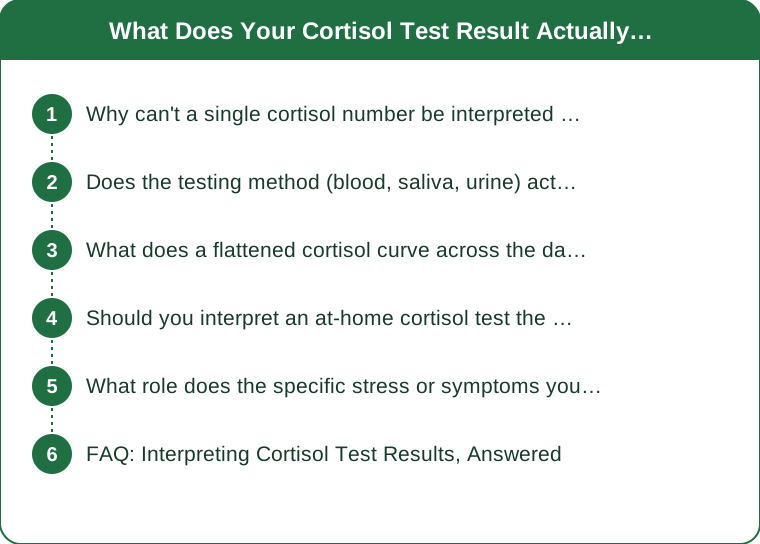
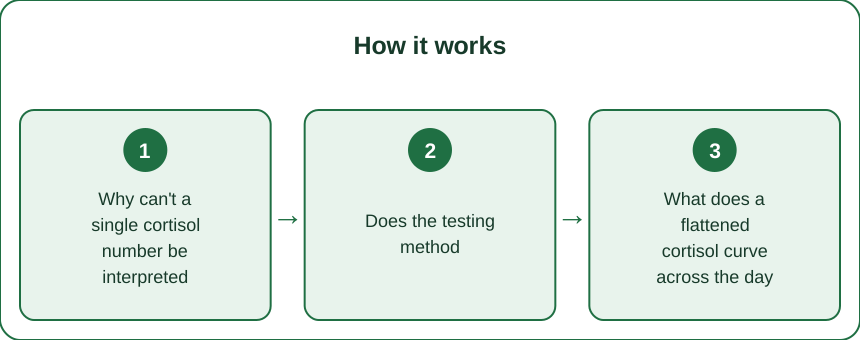
Why can’t a single cortisol number be interpreted without more context?
Cortisol follows a strong circadian pattern, peaking shortly after waking and gradually declining throughout the day, so the exact same cortisol level can be completely normal at 8am and clearly abnormal at 8pm. Any test result needs to be interpreted against the expected range for that specific collection time, not a single flat reference range.
Does the testing method (blood, saliva, urine) actually change what the result means?
Yes — blood tests measure total cortisol at a single moment, saliva tests measure free (unbound) cortisol and are often used for multiple daily samples to map the full curve, and urine tests measure cumulative cortisol output over 24 hours. These aren’t interchangeable, and a result from one method can’t be directly compared to a reference range built for a different method.
What does a flattened cortisol curve across the day actually indicate, versus a single elevated number?
A flattened curve — where cortisol doesn’t rise properly in the morning or doesn’t decline properly by evening — is often more clinically meaningful than a single elevated or low number, since it points to a disrupted daily rhythm rather than a simple excess or deficiency. This is why multi-sample saliva testing across a day often provides more useful information than a single blood draw.

Should you interpret an at-home cortisol test the same way as a lab-ordered one?
Not necessarily — at-home test kits vary significantly in accuracy and validation compared to clinically ordered lab tests, and results from consumer kits are best treated as a general signal rather than a diagnostic result. If an at-home result is concerning, following up with a healthcare provider for proper lab-based testing is the appropriate next step rather than self-diagnosing from the home kit alone.
What role does the specific stress or symptoms you’re testing for play in interpretation?
Cortisol testing is typically ordered to investigate specific suspected conditions (like Cushing’s syndrome or adrenal insufficiency) rather than as a general wellness check, and the reference ranges and follow-up protocols differ based on what’s actually being investigated. Testing cortisol without a specific clinical question in mind often produces a number that’s difficult to meaningfully act on.
FAQ: Interpreting Cortisol Test Results, Answered
Can stress alone cause a cortisol test to come back abnormal?
Yes, acute stress or even the stress of the blood draw itself can temporarily elevate cortisol, which is part of why timing and testing conditions matter so much.
Should I retest if my first cortisol result seems off?
A healthcare provider can advise whether a repeat test, a different testing method, or additional related tests are the appropriate next step.
Does a single normal cortisol reading rule out a cortisol-related issue?
Not necessarily — given how much cortisol fluctuates, a single normal reading doesn’t fully rule out a disrupted daily pattern that a single-timepoint test might miss. This is general information, not medical advice.
TL;DR:
- A cortisol number only makes sense in the context of the time of day it was measured
- Blood, saliva, and urine tests measure different things and aren’t directly comparable
- A flattened daily curve is often more meaningful than one high or low number
- At-home test kits are a general signal, not a diagnostic replacement for lab testing
If you’re holding a cortisol result and unsure what it means, bring the collection time and method to your provider — that context is what actually makes the number interpretable.
Keep Reading
This article is for general informational purposes only and is not medical advice. Always consult a qualified health professional for guidance specific to you.