Does Cold Exposure Actually Lower Cortisol? Your Questions, Answered
Quick Answer: In the short term, cold exposure raises stress hormones rather than lowering them - noradrenaline rises sharply, and cortisol responses in studies are mixed but generally show an acute increase or no change rather than a decrease. The calm people report afterwards comes from the rebound and from raised dopamine, not from a cortisol drop. The plausible longer-term case is different and more interesting: repeated cold exposure appears to blunt the stress response over time, so the same stressor produces a smaller reaction. That is habituation, and it takes weeks. Anyone plunging for an immediate cortisol reduction has the mechanism backwards, which mostly matters for timing.
The feeling afterwards is real. The explanation attached to it usually is not.
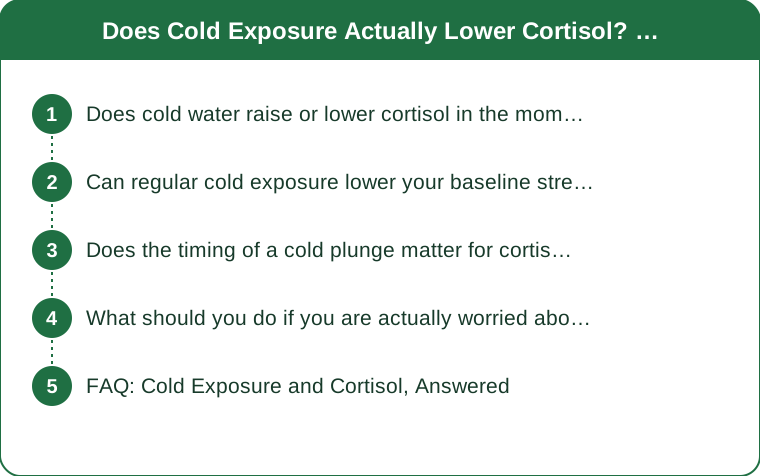
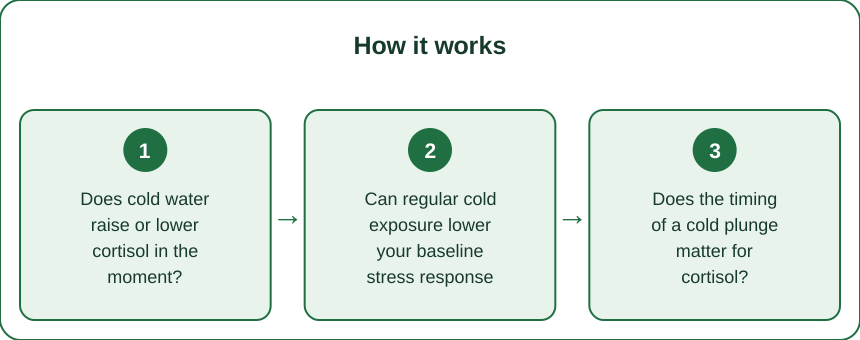
Does cold water raise or lower cortisol in the moment?
It raises stress signalling, and the cortisol picture specifically is mixed.
What is well established is the catecholamine response. Cold water immersion produces a large, rapid rise in noradrenaline - studies have reported multiples of baseline, sustained for a substantial period after exit. Adrenaline rises too, though more transiently. This is a straightforward sympathetic nervous system activation, and it happens whether or not you feel calm about it.
Cortisol is slower and less consistent. It is released through the HPA axis, which operates on a timescale of tens of minutes rather than seconds. Studies examining cortisol after cold water immersion have produced a range of results - some showing an acute rise, some showing no significant change, some showing a decrease at later time points. The variability likely reflects differences in water temperature, duration, whether participants were habituated, and the time of day the measurement was taken.
What almost nothing shows is an immediate cortisol drop. So the claim that a cold plunge lowers cortisol, meaning right now, is not supported in the way it is usually stated.
So why does it feel calming?
Three contributors, none of which is cortisol:
- The parasympathetic rebound. After a sharp sympathetic spike, there is a compensatory swing the other way. That is the settled, clear-headed state people describe.
- Dopamine. Cold exposure has been reported to raise dopamine substantially, with a slow rise and a long tail - potentially hours. This maps well onto the sustained mood lift people report and is probably the main driver of why it feels good afterwards.
- Mastery. Voluntarily doing something difficult and completing it produces a genuine psychological effect that has nothing to do with hormones.
The distinction that matters: feeling calm and having low stress hormones are not the same measurement, and they can move in opposite directions for a while.
Can regular cold exposure lower your baseline stress response over time?
This is the stronger version of the claim, and it has better support.
The relevant concept is cross-adaptation: repeated exposure to one stressor reduces the physiological response to that stressor, and possibly to others. Studies of habituated cold-water swimmers have found blunted catecholamine and cortisol responses to cold compared with unhabituated people - the same immersion produces a smaller hormonal reaction after several weeks of regular exposure.
What that means practically: you are not lowering cortisol during the plunge. You are training the system to react less strongly, and the adaptation appears within roughly two to six weeks of regular exposure, several times a week.
Whether it generalises to other stressors is less certain. Some research suggests cold-adapted individuals show reduced responses to unrelated stressors, which would be a genuinely useful effect. The evidence is suggestive rather than conclusive, and the studies are mostly small.
What about the mood and wellbeing findings?
Several studies of cold water swimming and cold showers report improvements in mood, reduced reported stress, and fewer sick days. These are real findings and worth taking seriously. They are also confounded in the obvious ways - cold water swimming usually involves being outdoors, in daylight, often socially, and doing something with a strong sense of ritual, all of which independently affect mood.
The honest summary: the psychological evidence is more consistent than the hormonal evidence, and it does not depend on cortisol doing anything in particular.
Is there a dose where it stops helping?
Probably. Cold exposure is a stressor, and stressors follow a dose-response curve where too much stops being adaptive. Very frequent, very long, very cold sessions on top of hard training and poor sleep is adding load to a system that may already be loaded. If you are exhausted, sleeping badly, and plunging daily to fix it, the plunge is a plausible part of the problem rather than the solution.
Does the timing of a cold plunge matter for cortisol?
Yes, and this is where the mechanism becomes practically useful.
Cortisol follows a strong daily rhythm. It rises sharply in the 30 to 45 minutes after waking - the cortisol awakening response - peaks in the morning, and declines through the day to a low point around midnight.
Morning
A plunge in the morning lands on top of a naturally rising curve. This is generally the best time, for two reasons: it reinforces an alerting signal at the point in the day when alertness is useful, and the catecholamine tail has all day to clear.
It does mean the acute stress response is added to an already elevated cortisol level. For most people this is unremarkable. For someone already dealing with significant stress or poor sleep, stacking a strong stressor onto the morning peak is worth being thoughtful about.
Evening
An evening plunge introduces an alerting stimulus when cortisol should be at its lowest and the body is preparing for sleep. The noradrenaline surge is the concern, and finishing at least 90 minutes before bed is the usual advice. If you plunge at 9pm and struggle to fall asleep, that is the likely mechanism.
Around training
A separate consideration entirely. Cold immersion soon after strength training appears to blunt some of the muscle adaptation to that session - the inflammatory signalling being suppressed is part of how the adaptation happens. If strength or muscle growth is your goal, leaving several hours or plunging on non-training days is the conservative approach. For recovery between competition sessions, where tomorrow’s performance matters more than long-term adaptation, the calculation is different.
Fasted or fed?
No good evidence that it matters for the cortisol response. Practically, very cold exposure on an empty stomach makes some people lightheaded, which is a reason to eat something rather than a hormonal one.
What should you do if you are actually worried about cortisol?
This is worth separating from the plunge question entirely, because the interventions with the best evidence are unglamorous.
What has the strongest evidence for lowering chronic cortisol
- Sleep. Sleep restriction reliably raises evening cortisol and flattens the daily curve. Nothing else on this list comes close to the effect size of consistently sleeping enough.
- Not chronically under-eating. Significant energy restriction raises cortisol. This catches out a lot of people who are simultaneously dieting hard, training hard, and trying to fix their stress.
- Appropriate training load. Exercise raises cortisol acutely - that is normal and desirable. Chronic excessive training volume without recovery raises it persistently, which is not.
- Daylight in the morning, which anchors the whole rhythm including the cortisol curve.
- Caffeine timing. Caffeine raises cortisol, and the effect is larger in people who are not habituated. A late afternoon coffee has downstream effects on sleep, which affects cortisol the next day.
- Slow breathing, and time not being stimulated. Small effect per session, reliable, free.
Where cold exposure fits
As a possible contributor to stress resilience over weeks, and as something people genuinely enjoy and find grounding. Not as an acute cortisol-lowering tool, and not as a substitute for sleep.
On cortisol testing
A single cortisol reading is close to meaningless without knowing the time it was taken, and salivary cortisol varies enormously across a day. If you have symptoms suggesting a genuine endocrine problem - unexplained weight change, muscle weakness, unusual fat distribution, persistent very low or very high blood pressure, deep fatigue that does not respond to rest - that is a conversation with a doctor and a properly structured test, not a home kit.
Who should be cautious with cold exposure regardless: anyone with a heart condition, high blood pressure, arrhythmia, Raynaud’s, a history of fainting, or who is pregnant. The cold shock response raises heart rate and blood pressure abruptly. Never plunge alone, and never after alcohol.
This is general information, not medical advice. Speak to a professional before starting cold water immersion if you have any cardiovascular condition, and about any symptoms you think may be hormonal.
FAQ: Cold Exposure and Cortisol, Answered
Is a cold shower enough or do I need a plunge?
For mood and habituation effects, cold showers appear to produce meaningful benefits and are far more sustainable. The hormonal response is milder because less surface area is exposed for less time, which is fine if resilience rather than intensity is the goal.
How cold and how long?
Most of the research uses water around 10 to 15C for 2 to 5 minutes. Colder and longer is not proportionally better and raises the risk. Two to three minutes is a reasonable working session for most people.
Will it help if I am burnt out?
Be careful. Adding a strong acute stressor to a system that is already overloaded is not obviously helpful, and the interventions with the best evidence for burnout are sleep, reduced load, and support. A cold shower is unlikely to hurt; daily long plunges on top of exhaustion might.
Does it help belly fat through cortisol?
The cortisol and abdominal fat relationship is real but modest and mostly relevant in chronic elevation or clinical conditions. There is no good evidence that cold exposure changes body fat distribution through this route. Cold does activate brown fat and increase energy expenditure slightly, which is a different and small effect.
How long until I notice the adaptation?
The blunted response to cold itself typically appears within two to six weeks of regular exposure - most people notice the gasp reflex and the subjective severity reducing before any measurement would show it.
TL;DR:
- Cold exposure raises stress signalling acutely - a large noradrenaline surge, with cortisol responses mixed but not lowered.
- The calm afterwards is parasympathetic rebound plus dopamine, not a cortisol drop.
- The better-supported claim is habituation over 2 to 6 weeks: the same cold produces a smaller hormonal response.
- Morning is the better slot. Evening plunges should finish 90+ minutes before bed, and post-strength-training immersion may blunt adaptation.
- If chronic cortisol is the real concern, sleep, adequate food, sane training load, and morning daylight outrank cold exposure by a wide margin.
Plunge because you like it and because resilience builds over weeks. Do not plunge expecting a stress hormone to fall in the next ten minutes.
Keep Reading
This article is for general informational purposes only and is not medical advice. Always consult a qualified health professional for guidance specific to you.