Does Delaying Your Morning Coffee Actually Lower Cortisol?
Quick Answer: The theory sounds tidy - cortisol peaks after waking, so caffeine then is wasted or harmful - but no solid trial shows that delaying coffee 90 minutes lowers cortisol meaningfully, prevents afternoon crashes, or improves energy. Morning cortisol is a healthy wake-up signal, not a problem; caffeine’s acute cortisol bump is modest and shrinks with habit. Delaying is harmless if you like it. The levers with actual evidence: total dose, a cutoff eight-plus hours before bed, sleep itself, and morning light.
Somewhere between a podcast and your group chat, coffee acquired a waiting period. The claim deserves credit for being about biology at all - and scrutiny for how far past the data it sprinted. Here is the fair audit, mug in hand.

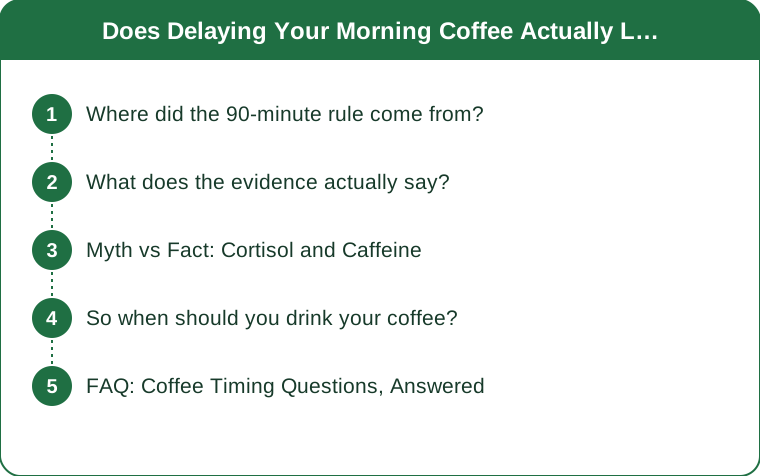
Where did the 90-minute rule come from?
From stitching together three true facts into one untested recommendation.
True fact one: the cortisol awakening response. Cortisol - your mobilizing, get-up-and-function hormone - surges roughly 30 to 45 minutes after you wake, a healthy, well-documented spike that helps convert sleep inertia into alertness. It is highest in the first hour of the morning and drifts down across the day.
True fact two: caffeine can nudge cortisol. In studies, caffeine acutely raises cortisol somewhat - most clearly in people who rarely consume it, much less in daily drinkers, whose response is substantially blunted.
True fact three: caffeine blocks adenosine, and adenosine is the sleepiness molecule. Waking up with some residual adenosine on board, the reasoning goes, means caffeine taken immediately masks grogginess that would clear on its own - so wait, let cortisol do the morning shift, then deploy caffeine as reinforcements, and supposedly dodge an afternoon crash.
The leap: therefore everyone should wait 90 minutes. That last step - the actual recommendation - is the part without a controlled trial behind it. No published study has randomized people to immediate versus delayed coffee and measured cortisol rhythms, afternoon energy, or performance. The rule is a plausible story built on real physiology, popularized because it is specific, free, and sounds like insider knowledge. Plausible stories are where science starts, not where advice should.
What does the evidence actually say?
Auditing each claim against what has been measured:
Claim: coffee at waking spikes cortisol dangerously on top of the peak. The measured caffeine-cortisol bump in habitual drinkers is modest - tolerance develops specifically to this effect - and no evidence ties coffee-at-waking to cortisol dysregulation in healthy people. Morning cortisol is also not a villain to minimize: a robust awakening response is generally a marker of a healthy rhythm. The premise mistakes a feature for a bug.
Claim: delaying prevents the afternoon crash. Untested directly - and the crash has better-documented parents: accumulated sleep debt, the natural early-afternoon circadian dip that hits regardless of coffee timing, a large lunch, and caffeine consumed late enough to disturb the previous night’s sleep. Blaming the 7am latte for the 2pm slump skips every likelier suspect.
Claim: caffeine is wasted while adenosine is still clearing. Partially reasonable in mechanism, but mornings-after-decent-sleep carry little residual adenosine anyway - and anyone who has felt a first sip land knows the subjective effect is not absent at 7am.
What delay defenders can fairly keep: the experiment costs nothing, harms nothing, and some people genuinely report liking the sequence - often, plausibly, because the delay smuggles in water, breakfast, daylight, and a calmer start before the caffeine arrives. Those co-travelers have their own benefits, no hormone theory required.
The grown-up summary: not debunked so much as unproven - a lifestyle preference wearing a lab coat.

Myth vs Fact: Cortisol and Caffeine
Myth: Cortisol is bad and mornings should minimize it. Fact: Cortisol is your built-in morning engine - mobilizing fuel, sharpening attention, telling every system the day has begun. Chronically elevated stress patterns are a health concern; the daily dawn peak is the opposite of one.
Myth: Coffee at waking burns out your adrenals. Fact: Adrenal fatigue is not a recognized medical diagnosis, and routine coffee does not exhaust cortisol production. Persistent exhaustion has real causes worth investigating properly - iron, thyroid, sleep disorders, depression among them - with a clinician rather than a caffeine schedule. This is general information, not medical advice.
Myth: The afternoon crash proves your coffee timing is wrong. Fact: The early-afternoon dip is built into human circadian rhythm and shows up in people who drink no coffee at all. Short sleep deepens it; heavy lunches decorate it. Timing breakfast coffee differently is the weakest lever on that list.
Myth: If delaying feels better, the cortisol theory was right. Fact: A delayed coffee usually arrives after water, food, light, and forty minutes of being vertical - all independently alerting. Feeling better confirms the routine works for you, not the mechanism marketed with it.
Myth: Everyone should follow the same caffeine clock. Fact: Caffeine metabolism varies severalfold between people. The slow metabolizer jittery at noon and the fast metabolizer fine after dinner are both normal - which is exactly why personal experiments beat universal rules.
So when should you drink your coffee?
Ranked by evidence, here is where morning-coffee attention actually pays:
Lever one: the cutoff, not the start. Caffeine within six-plus hours of bedtime measurably degrades sleep - and damaged sleep is the true cortisol-and-energy story. Set a personal curfew eight to ten hours before bed and guard it like it matters, because it does. Everything about tomorrow morning’s energy is downstream of tonight.
Lever two: total dose. Up to around 400 milligrams daily sits fine with most healthy adults; creeping past your own comfort line shows up as jitters, anxiety, and worse sleep regardless of scheduling artistry.
Lever three: morning light. Ten minutes of outdoor light shortly after waking does more for your cortisol rhythm and evening sleepiness than any coffee choreography - and pairs beautifully with the mug, whenever you drink it.
Then, if curious, run the actual experiment. Two weeks of coffee-on-waking, two weeks of a 60-to-90-minute delay - same dose, same bedtime, notes each afternoon on energy and mood. Whichever fortnight reads better is your answer, and it outranks every podcast. Many people land on a split: a small early cup for the ritual, the rest mid-morning.
People with real reasons to reconsider timing or dose: anyone with anxiety that caffeine sharpens, reflux that mornings-on-empty aggravate, blood pressure concerns, pregnancy - where limits are lower and worth confirming with a clinician - and anyone whose supposed morning coffee need is masking a 5.5-hour sleep schedule. The mug was never the problem there.
And if you simply love coffee first thing and sleep well - the data has no complaint to file. Enjoy it hot.
FAQ: Coffee Timing Questions, Answered
Should I wait 90 minutes after waking to drink coffee?
Only if you enjoy the routine - no controlled evidence shows delayed coffee lowers cortisol meaningfully or prevents afternoon crashes. It is harmless to try; treat it as a personal experiment, not a health requirement.
Does coffee spike cortisol?
Acutely and modestly, with the effect notably blunted in regular drinkers. The morning cortisol peak itself is a healthy wake-up signal, not a hazard that coffee dangerously compounds.
Why do I crash every afternoon anyway?
Mostly the built-in early-afternoon circadian dip, deepened by short sleep, late caffeine the night before, and heavy lunches. Fix bedtime and the caffeine curfew before rearranging breakfast.
What is the healthiest way to drink morning coffee?
Keep the total moderate, stop eight to ten hours before bed, pair mornings with outdoor light and some water, and put the first cup wherever your own two-week experiment says it belongs.
TL;DR:
- The 90-minute delay is a plausible story without a trial - real physiology, untested advice.
- Morning cortisol is a feature; habitual drinkers barely bump it with coffee; the afternoon dip is circadian, not scheduling karma.
- The proven levers: caffeine cutoff eight-plus hours before bed, moderate total dose, morning light, and sleep itself.
- Curious? Run your own two-week crossover - your notes outrank anyone’s podcast.
Coffee timing is a preference wearing a hormone costume. Take the costume off and the real advice underneath is older and duller: sleep enough, stop early, go outside - mug optional, either way.
Keep Reading
This article is for general informational purposes only and is not medical advice. Always consult a qualified health professional for guidance specific to you.