Does One Bad Night's Sleep Actually Raise Your Cortisol the Next Day?
Quick Answer: Research on sleep restriction has found altered cortisol patterns - particularly higher evening cortisol and a slower decline across the day after sleep loss - but the effect of one bad night is smaller and more variable than the internet implies. The wired-and-tired feeling after poor sleep involves adenosine, adrenaline, disrupted circadian timing, and impaired glucose handling, not cortisol alone. One bad night is a recoverable event. Repeated short sleep across weeks is the pattern that matters, and that’s where the effort belongs.
Every symptom of a bad night gets attributed to cortisol now. Some of that is fair. Most of it is a single word being asked to explain a whole physiology.

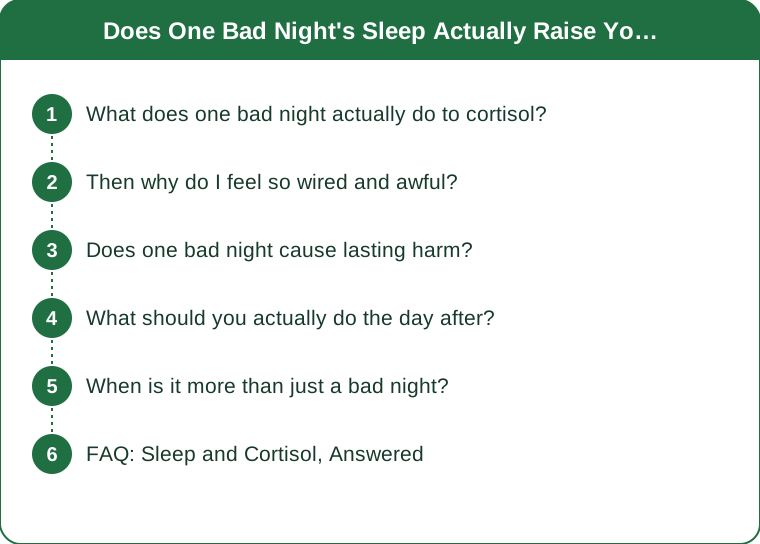
What does one bad night actually do to cortisol?
Studies on sleep restriction have found changes, but the picture is nuanced. Some research on partial sleep deprivation reports elevated cortisol in the evening following sleep loss, and a slower decline across the day - meaning the shape of the curve shifts more than the total necessarily does.
The morning response is less consistent. Findings on the cortisol awakening response after a poor night are mixed across studies, with some showing increases, some decreases, and considerable individual variation.
One night is a small dose. Most of the clearer findings come from studies of repeated restriction over several nights, not from a single disrupted night, which is a much weaker stimulus.
Individual variation is large. People differ substantially in their cortisol response to sleep loss, which is one reason single-study headlines translate poorly to personal experience.
And measuring it wouldn’t help you anyway. A one-off cortisol test reflects a single moment on a curve that varies hour by hour and day by day, which is why clinicians use cortisol testing for specific suspected conditions rather than as a general wellness measure.
The honest position: probably some effect, modest, variable. That’s a much less satisfying answer than the confident version, and it’s closer to what the research supports.
Then why do I feel so wired and awful?
Adenosine builds up and doesn’t get cleared. Adenosine accumulates during waking hours and creates sleep pressure; sleep clears it. A short night leaves you starting the day with a backlog, which is the heavy, foggy component.
Sleep loss impairs the prefrontal cortex disproportionately. Attention, decision-making, and emotional regulation all degrade measurably, which is why a bad night makes ordinary problems feel much larger.
Your circadian timing gets disrupted, not just your sleep duration. Going to bed late or waking repeatedly shifts the timing of the whole system. Feeling wrong at the wrong times of day is a timing problem as much as a quantity one.
Adrenaline and the sympathetic nervous system contribute. The wired part of wired-and-tired is more plausibly an alertness response than a cortisol effect - your body compensating for sleepiness with arousal.
Glucose handling worsens after short sleep. Research has found reduced insulin sensitivity after even brief sleep restriction, which contributes to the energy swings and the intense carbohydrate cravings.
And caffeine papers over it and then compounds it. Extra coffee to cope means more caffeine later in the day, which affects the following night - which is how one bad night becomes three.
Does one bad night cause lasting harm?
No - it’s a recoverable event. A single night of poor sleep is a normal part of human life. The body handles it, and most of the effects resolve within a day or two of normal sleep.
Recovery sleep genuinely works. Sleeping longer the following night restores a substantial portion of what was lost, particularly deep sleep, which the body appears to prioritise.
You can’t fully bank or repay sleep. Recovery isn’t a simple ledger, and chronic short sleep across weeks isn’t erased by one long weekend lie-in - which is a different claim from saying recovery sleep is useless.
Chronic short sleep is the genuine concern. Sustained insufficient sleep is associated with meaningful health outcomes across cardiovascular, metabolic, and mental health measures. That’s where the evidence is strong and where attention is warranted.
Worrying about one bad night can cost you the next one. Anxiety about sleep is itself a well-documented driver of insomnia, and treating a single poor night as a crisis is a reliable way to produce a second.
And the transition weeks make bad nights more likely. Schedules restarting, darker mornings, and changing evening light all disrupt sleep timing around now - which is worth knowing so you attribute it correctly rather than to something wrong with you.

What should you actually do the day after?
Get outside into morning light. It’s the strongest signal for re-anchoring your body clock, and it’s more useful than anything else on this list after a disrupted night.
Keep your wake time normal. Sleeping in substantially shifts your clock later and makes the following night worse. Getting up at your usual time, even tired, is usually the better trade.
Cap the caffeine and cut it off early. More coffee is the instinct and the cost lands on the following night. A firm afternoon cut-off matters more on a bad day than a good one.
Eat regularly and prioritise protein. Sleep loss increases appetite and cravings for quick carbohydrates, and eating properly reduces the energy swings that make the day feel worse than it is.
Take a nap if you can, and keep it short and early. Twenty to thirty minutes in the early afternoon restores alertness without much impact on the coming night. Long or late naps do the opposite.
Downgrade the training rather than cancelling it. A walk or an easy session is usually better than either a hard session or nothing. Hard training on very little sleep tends to produce a poor session and worse recovery.
When is it more than just a bad night?
When it’s a pattern rather than an event. Weeks of consistently poor sleep is a different thing from one bad night, and it’s the version worth taking to a clinician.
When you’re sleeping enough hours and still exhausted. Unrefreshing sleep despite adequate duration can point to sleep apnoea, thyroid issues, anaemia, or other treatable causes - and it’s a common reason people spend months chasing cortisol when the answer is elsewhere.
When you snore heavily or stop breathing. Reported snoring with pauses, or waking gasping, warrants assessment. Sleep apnoea is common, frequently undiagnosed in women, and treatable.
When anxiety about sleep has become the problem. Insomnia that’s driven by worry about sleeping responds well to cognitive behavioural therapy for insomnia, which is a first-line recommended treatment rather than a last resort.
When there are other symptoms alongside it. Unexplained weight change, persistent low mood, changes in periods, or new physical symptoms all move this from a lifestyle question to a clinical one.
This is general information, not medical advice. If you suspect a genuine cortisol disorder, that’s diagnosed by a clinician with proper testing, not by symptom lists online. Both excess and deficiency are real conditions with specific presentations, and neither is diagnosed by feeling tired and stressed.
FAQ: Sleep and Cortisol, Answered
Does one bad night’s sleep raise cortisol?
Research on sleep restriction has found altered cortisol patterns, particularly higher evening levels and a slower daily decline, but findings for a single night are more modest and more variable than commonly claimed.
Why do I feel wired but exhausted after bad sleep?
It’s a combination - adenosine backlog creating heaviness, sympathetic arousal creating the wired feeling, disrupted circadian timing, and impaired glucose handling. Cortisol is one input among several rather than the whole explanation.
Should I sleep in after a bad night?
A modest lie-in is fine, but sleeping in substantially shifts your body clock later and tends to make the following night harder. Keeping close to your usual wake time and getting morning light is usually the better trade.
Can I test my cortisol to find out?
A one-off test reflects a single point on a curve that varies through the day and between days. Clinicians use cortisol testing to investigate specific suspected conditions, not as a general measure of stress or tiredness.
TL;DR:
- Sleep restriction research shows altered cortisol patterns, but the effect of a single bad night is modest and highly variable.
- The wired-and-tired feeling involves adenosine, sympathetic arousal, circadian disruption, and glucose handling - not cortisol alone.
- One bad night is recoverable; repeated short sleep across weeks is the pattern that actually matters.
- The day after: morning light, normal wake time, capped caffeine with an early cut-off, regular meals, a short early nap, easier training.
- Persistent unrefreshing sleep, heavy snoring with pauses, or sleep anxiety are clinical questions, not cortisol questions.
Worrying about one bad night is one of the more reliable ways to produce a second one.
Keep Reading
This article is for general informational purposes only and is not medical advice. Always consult a qualified health professional for guidance specific to you.