Does Heat Raise Cortisol? Summer Stress Questions, Answered
Quick Answer: Yes — heat is a physiological stressor and acute heat exposure raises cortisol, particularly during exercise in high temperatures. The bigger practical issue in late summer is indirect: hot nights fragment sleep, and poor sleep is one of the most reliable drivers of elevated cortisol there is. Fix the sleep before you worry about the heat.
By late August a lot of people feel wired, poorly rested, and unusually reactive to small things.
Summer stress is a real physiological phenomenon rather than a vibe — and understanding which part is the heat and which part is the sleep tells you what is worth changing.

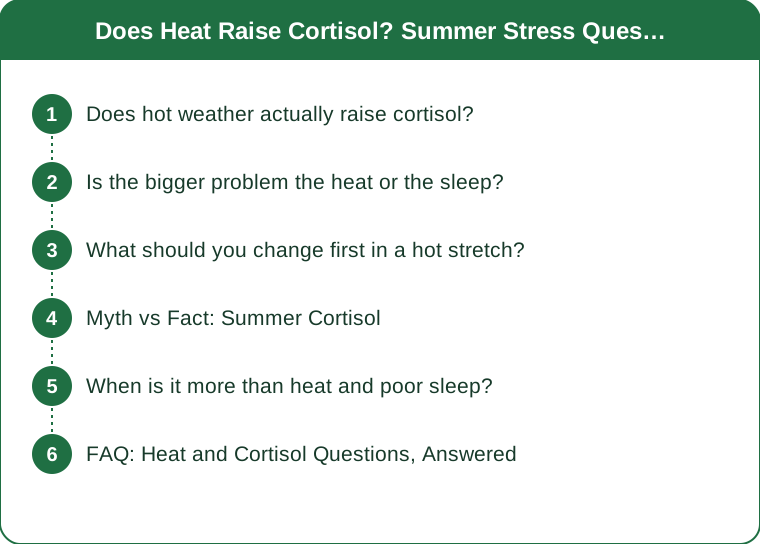
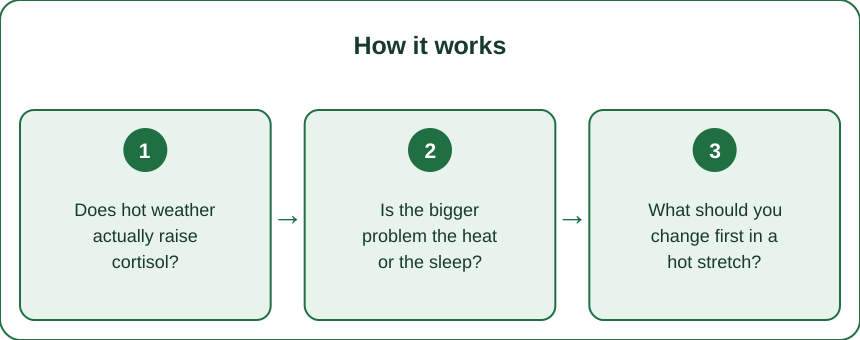
Does hot weather actually raise cortisol?
Acutely, yes. Heat stress activates the same axis that psychological stress does, and cortisol rises in response to significant heat exposure — the effect is most consistently demonstrated during exercise in the heat, where the combined load is substantial.
Passive heat — sitting in a hot room — produces a much smaller response. Your body handles a warm afternoon without a meaningful hormonal event. It is heat plus effort, or heat plus dehydration, where the response becomes noticeable.
A few things scale the effect up:
- Dehydration. Being underhydrated amplifies the cortisol response to heat substantially, and it is the most controllable factor here.
- Humidity, because it impairs your ability to shed heat through sweating.
- Lack of acclimatization. The first hot week of a season produces a much larger stress response than the same conditions six weeks later. Your body genuinely adapts.
The reassuring part: an acute cortisol rise from a hot workout is a normal, appropriate response, not damage. It is the same category as the rise from any hard training session. The concern is chronic elevation, which heat alone rarely produces — but which poor sleep readily does.
Is the bigger problem the heat or the sleep?
The sleep, in almost every case.
Hot nights fragment sleep in a specific way. Your core temperature needs to fall by roughly 1 to 2°F to initiate and maintain sleep, and a bedroom above about 70°F makes that harder. The result is more time in light sleep, more awakenings, and less slow-wave sleep — often without you fully waking up enough to remember it.
And sleep restriction is one of the most reliable ways to raise evening cortisol in the research literature. It shows up consistently: a run of short or fragmented nights elevates cortisol in the late afternoon and evening, which is exactly the wired-but-tired pattern people describe.
So the causal chain in late summer is usually: hot nights → fragmented sleep → elevated evening cortisol → feeling wired at 10 p.m. and exhausted at 3 p.m. The heat is upstream, but sleep is the mechanism.
This matters because it tells you where to intervene. Cooling your bedroom is a cortisol intervention. So is moving your workout out of the afternoon heat, because a hot late-day session raises both core temperature and cortisol close to bedtime — a double hit on sleep quality.
What should you change first in a hot stretch?
In order of impact:
1. Cool the bedroom to 65 to 68°F. The most effective single change available. If air conditioning is not an option, a fan moving air across the bed, a cool shower before bed, and blackout curtains closed during the day all help meaningfully.
2. Move hard training out of peak heat. Early morning or after sunset. A hard session at 4 p.m. in August raises core temperature for hours and pushes cortisol up in the window when it should be falling.
3. Hydrate deliberately, with electrolytes if you are sweating heavily. Dehydration amplifies the heat cortisol response and is the easiest factor to control. Pale-yellow urine is the practical marker.
4. Protect the morning light exposure anyway. Cortisol is supposed to spike in the morning — that is the healthy cortisol awakening response, and morning daylight sharpens it, which also helps the evening decline.
5. Do not add caffeine to compensate. The instinct after a bad night is more coffee later in the day, which raises cortisol and further degrades the next night. This is the loop that turns one bad night into a bad fortnight.

Myth vs Fact: Summer Cortisol
Myth: Elevated cortisol from heat causes weight gain. Fact: Acute cortisol rises from heat or exercise do not drive fat gain. Chronic sleep restriction affects appetite regulation and food choices, and that pathway is far more relevant than the hormone level itself.
Myth: You should avoid exercising in heat to protect your cortisol. Fact: Heat acclimatization is a genuine adaptation, and training in heat has real cardiovascular benefits. The issue is timing, hydration, and intensity — not exercising at all. Adapt gradually over one to two weeks rather than avoiding it.
Myth: Cortisol supplements or adaptogens fix summer stress. Fact: The evidence for most of these is thin. Sleeping in a cool room outperforms every supplement in this category, and it is free.
Myth: Feeling wired at night means high cortisol specifically. Fact: Possible, but so are late caffeine, evening light exposure, an elevated core temperature from a late workout, and simple sleep debt. Cortisol is the most fashionable explanation, not the most likely one.
Myth: A saliva cortisol test will tell you what is happening. Fact: Cortisol varies enormously through the day and between days, so single-point at-home tests are difficult to interpret meaningfully. If you genuinely suspect a cortisol disorder, that is a clinical workup with your doctor, not a home kit.
When is it more than heat and poor sleep?
Most late-summer wired-and-tired resolves within a week or two of cooling the bedroom and adjusting training time. Some does not, and there are patterns worth taking to a doctor.
Worth an appointment if:
- Exhaustion persists after several weeks of genuinely good sleep
- You have unexplained weight change, particularly central weight gain with thinning limbs
- New purple or wide stretch marks, easy bruising, or skin that has become noticeably thin
- Persistent muscle weakness, especially getting up from chairs or climbing stairs
- Dizziness on standing, salt cravings, and darkening skin — a different pattern, pointing the opposite direction
- Blood pressure or blood sugar has changed without an obvious explanation
Genuine cortisol disorders — Cushing’s syndrome and adrenal insufficiency — are uncommon but real, and they present with recognizable clusters rather than with tiredness alone.
One term worth setting aside: “adrenal fatigue” is not a recognized medical diagnosis, and searching it mostly surfaces supplements. The underlying tiredness is real and deserves proper investigation — thyroid function, iron and ferritin, sleep apnea, depression, and perimenopause are all far more common explanations and all are treatable. This is general information, not medical advice.
FAQ: Heat and Cortisol Questions, Answered
Does a sauna raise cortisol?
Acutely yes, similar to other heat exposure, and it returns to baseline afterward. Regular sauna use is associated with a range of positive outcomes in observational research, so the transient rise is not a reason to avoid it. Avoid it close to bedtime, though — the delayed core temperature drop can help sleep, but only if you finish 90-plus minutes before bed.
Should I stop morning workouts because cortisol is already high then?
No. The morning cortisol peak is a normal, healthy rhythm, and exercising during it is fine — arguably better aligned than an evening session. The “do not train in the morning because of cortisol” advice is not well supported.
How long does heat acclimatization take?
Most adaptation happens within 7 to 14 days of regular heat exposure, with the largest changes in the first week. This is why the first hot week of summer feels dramatically worse than an identical week in August — and why a cool stretch followed by a heatwave feels like starting over.
TL;DR: Heat raises cortisol acutely, but hot nights are what actually make late summer feel awful.
- Heat plus exercise or dehydration produces the meaningful acute response; sitting in a warm room barely registers.
- The real chain is hot nights → fragmented sleep → elevated evening cortisol — wired at 10 p.m., flat at 3 p.m.
- Cool the bedroom to 65 to 68°F. Highest-impact change available, and it beats every supplement in this category.
- Move hard training out of peak heat, hydrate deliberately, and keep morning daylight exposure.
- Do not add afternoon caffeine to compensate — that is the loop that extends a bad night into a bad fortnight.
- Acclimatization takes 7 to 14 days, which is why the first hot week is always the worst.
- Persistent exhaustion despite good sleep deserves a doctor, not a cortisol supplement.
Fix the bedroom temperature first. Most of the rest follows.
Keep Reading
This article is for general informational purposes only and is not medical advice. Always consult a qualified health professional for guidance specific to you.