Is Cortisol Actually My Problem? Sorting the Claims From the Physiology
Quick Answer: Cortisol follows a daily rhythm - highest shortly after waking, declining through the day. Most popular claims about ‘high cortisol’ describe normal variation or symptoms with many possible causes. Genuine cortisol disorders exist, are relatively uncommon, and are diagnosed through specific medical testing rather than symptom checklists or at-home saliva panels.
Cortisol has become the explanation of choice for a wide range of complaints, which is a reasonable sign that it is being asked to explain too much.

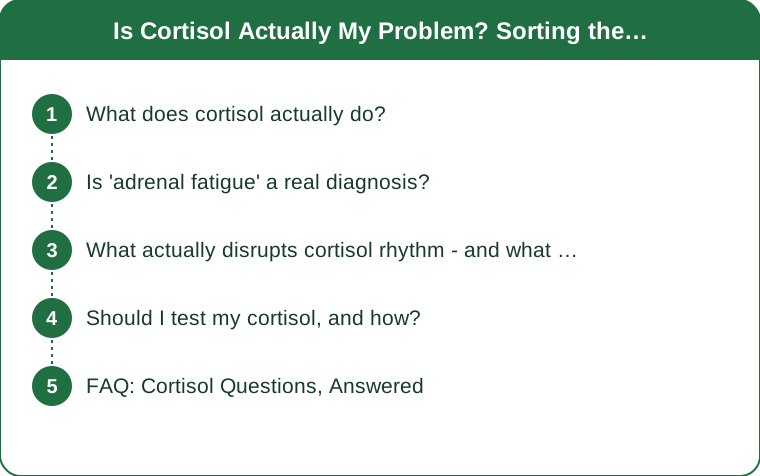
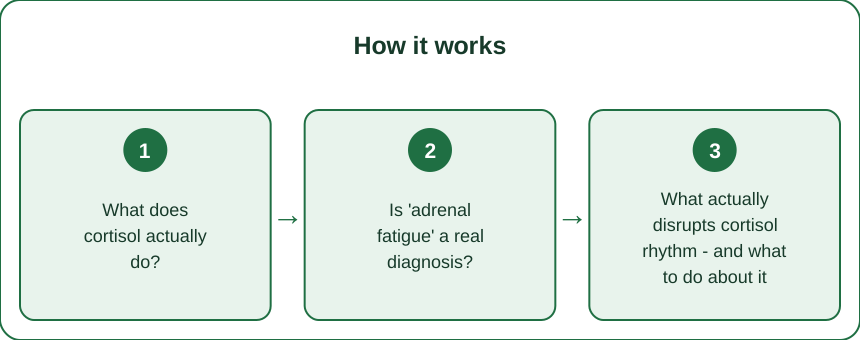
What does cortisol actually do?
Considerably more than the stress framing suggests.
Cortisol is a glucocorticoid hormone produced by the adrenal glands, regulated by a feedback loop involving the hypothalamus and pituitary - the HPA axis. It is essential for life, not a problem hormone.
Its main roles:
- Regulating blood glucose by promoting gluconeogenesis
- Modulating immune and inflammatory responses
- Supporting blood pressure regulation
- Contributing to the daily wake-sleep rhythm
- Mobilising energy in response to demand, which is the stress role people know about
The daily pattern is the important part. Cortisol rises sharply in the 30 to 45 minutes after waking - the cortisol awakening response - then declines through the day to a low point around midnight. This rhythm is a normal, necessary feature, not a sign of stress.
Why this matters for interpreting how you feel:
- Feeling alert in the morning is cortisol working correctly
- A mid-afternoon dip is normal and relates to circadian factors more than to cortisol failure
- A single elevated reading means very little without knowing the time of day
Where the popular framing goes wrong: the idea that chronic stress produces persistently high cortisol which then causes weight gain, fatigue and poor sleep is an oversimplification of a complex regulatory system. Chronic stress does affect HPA axis function, but the pattern varies between individuals, and the downstream effects are not as direct as commonly presented.
Is ‘adrenal fatigue’ a real diagnosis?
No, and this matters because it redirects people away from finding the actual cause.
The claim. That prolonged stress exhausts the adrenal glands so they can no longer produce adequate cortisol, causing fatigue, brain fog, sleep problems and cravings.
The evidence position. Adrenal fatigue is not recognised as a medical diagnosis by endocrinology bodies. Systematic reviews examining the proposed link between fatigue and adrenal function have not found support for it. The symptom list is extremely non-specific and overlaps with a large number of genuine conditions.
Why that matters practically. Someone with persistent fatigue may have anaemia, thyroid dysfunction, sleep apnoea, depression, coeliac disease, diabetes, or any number of other things. Attributing it to adrenal fatigue means those do not get investigated, and some of them are straightforward to treat.
The conditions that genuinely involve cortisol:
- Cushing’s syndrome - excess cortisol, whether from a tumour or from prolonged corticosteroid medication. Features include central weight gain, a rounded face, purple stretch marks, easy bruising, muscle weakness and high blood pressure. It is uncommon and it is diagnosed through specific testing.
- Addison’s disease - adrenal insufficiency, involving fatigue, weight loss, low blood pressure, salt cravings and skin darkening. Rare, serious, and requiring treatment.
- Secondary adrenal insufficiency, most commonly following abrupt withdrawal from long-term steroid medication
The distinguishing feature of the real conditions: they involve objective clinical signs alongside symptoms, and they are confirmed by testing. They are not diagnosed from a symptom quiz.
This is general information, not medical advice. Persistent fatigue, unexplained weight change, or the specific features above should be assessed by a doctor.

What actually disrupts cortisol rhythm - and what to do about it
The rhythm is more responsive to some inputs than others, and the effective interventions are unglamorous.
Genuinely disruptive:
- Insufficient or irregular sleep, which is the single largest modifiable factor. Sleep restriction measurably alters cortisol patterns, particularly the evening decline.
- Shift work and irregular schedules, which disrupt the circadian signal the rhythm depends on
- Chronic psychological stress, though the effects on the HPA axis vary substantially between individuals
- Very high training loads without adequate recovery, which is well documented in athletes
- Significant energy restriction, particularly combined with high training volume
- Alcohol, which disrupts both sleep architecture and hormonal regulation
Frequently blamed, weakly supported:
- Caffeine. It does produce a transient cortisol rise, but tolerance develops with habitual use and the effect is modest. Caffeine’s bigger impact is on sleep, which then affects everything else.
- Specific foods and ‘cortisol-lowering’ supplements, most of which have thin evidence. Some adaptogens have preliminary research; none has strong evidence for a clinically meaningful effect.
- Exercise timing. Any exercise raises cortisol acutely, which is a normal and appropriate response. This is not something to avoid.
What actually helps, in order of evidence:
- Consistent sleep timing, with a stable wake time. The highest-return intervention by a wide margin.
- Morning outdoor light, which reinforces the circadian signal the cortisol rhythm follows
- Regular moderate exercise, which improves stress resilience over time despite raising cortisol acutely
- Adequate energy intake, particularly for anyone training regularly
- Evidence-based stress management - mindfulness-based approaches and cognitive behavioural techniques both have reasonable support
- Limiting alcohol, especially close to bedtime
What all of these have in common: they are the same interventions that help sleep, mood and energy generally. This is not a coincidence - it is a hint that cortisol may be a downstream marker rather than the root cause.
Should I test my cortisol, and how?
Sometimes yes, and the method matters a great deal.
When testing is clinically warranted:
- Specific signs of Cushing’s syndrome - central weight gain with thin limbs, purple abdominal stretch marks, easy bruising, a rounded face, proximal muscle weakness
- Specific signs of adrenal insufficiency - unexplained weight loss, low blood pressure, salt craving, skin darkening, persistent nausea
- After long-term corticosteroid use, where adrenal suppression is a genuine risk
- Unexplained persistent symptoms that a doctor considers warrant investigation
How clinical testing is actually done:
- Morning serum cortisol, timed carefully because of the daily rhythm
- 24-hour urinary free cortisol, capturing total daily output
- Late-night salivary cortisol, which detects loss of the normal evening decline
- Dexamethasone suppression testing, which assesses whether the feedback loop is functioning
- ACTH stimulation testing for suspected insufficiency
Why direct-to-consumer saliva panels are problematic:
- Cortisol varies enormously through the day, so a small number of samples is a limited picture
- Results are commonly interpreted against non-clinical reference ranges
- A result inside or outside a range without clinical context does not establish a diagnosis
- They frequently produce findings that lead to supplement purchases rather than to investigation of the actual cause
A reasonable approach if you have persistent symptoms: see a doctor, describe the symptoms and their timeline, and let the clinical picture determine what is tested. Fatigue is one of the most common presenting symptoms in primary care and has a long differential - cortisol is one item on a list that also includes thyroid function, iron status, blood glucose, sleep disorders and mood disorders.
This is general information and does not replace individual medical advice.
FAQ: Cortisol Questions, Answered
Does high cortisol cause belly fat?
Genuinely elevated cortisol from Cushing’s syndrome produces a characteristic central fat distribution, but that is an uncommon clinical condition. Normal cortisol variation from everyday stress does not explain typical weight change.
Is adrenal fatigue real?
It is not recognised as a medical diagnosis, and systematic reviews have not supported the proposed link between fatigue and adrenal function. Persistent fatigue deserves proper investigation of the many conditions that do cause it.
Do cortisol-lowering supplements work?
Evidence is generally weak. Some adaptogens have preliminary research, but nothing has strong support for a clinically meaningful effect. Sleep consistency has considerably better evidence and costs nothing.
Should I stop drinking coffee to lower cortisol?
Caffeine produces a modest transient rise and tolerance develops with habitual use. Its larger effect is on sleep, so the timing matters more than the total.
When should I see a doctor?
For persistent unexplained fatigue, unexplained weight change, or the specific features of Cushing’s or Addison’s described above. Symptom checklists cannot distinguish these from the many other causes - proper testing can. This is general information, not medical advice.
TL;DR:
- Cortisol follows a daily rhythm and is essential, not a problem hormone
- Adrenal fatigue is not a recognised diagnosis, and the label diverts attention from treatable causes
- Real cortisol disorders are uncommon, have objective clinical signs, and require specific testing
- Sleep consistency, morning light and adequate energy intake are the interventions with actual evidence
- Direct-to-consumer saliva panels rarely produce clinically useful information
If the symptoms are persistent, the useful move is a doctor and a proper differential rather than a hormone panel. Cortisol is often downstream of the thing actually worth fixing.
Keep Reading
This article is for general informational purposes only and is not medical advice. Always consult a qualified health professional for guidance specific to you.