Does Cutting Carbs Actually Spike Your Cortisol? What the Research Really Shows
Quick Answer: Very low carb intake can raise cortisol somewhat, mainly because your body treats significant carb restriction as a mild physiological stressor — but the effect is generally modest, varies a lot by individual, and is very different from the dramatic ‘carbs are destroying your hormones’ framing common on social media.
Every few months, a version of ‘low-carb diets are wrecking your cortisol’ goes around again, usually with a single alarming statistic detached from any context about study design, duration, or who was actually studied. It’s not entirely made up, but it’s also not the full picture — here’s how to actually parse it.

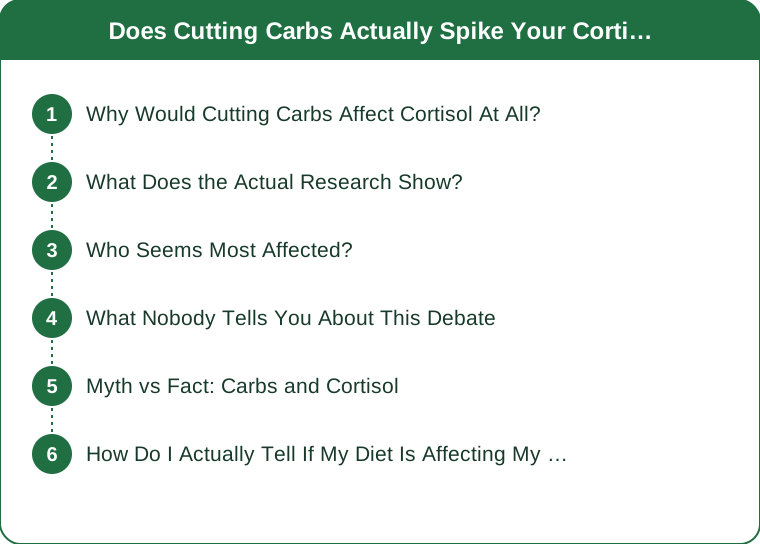
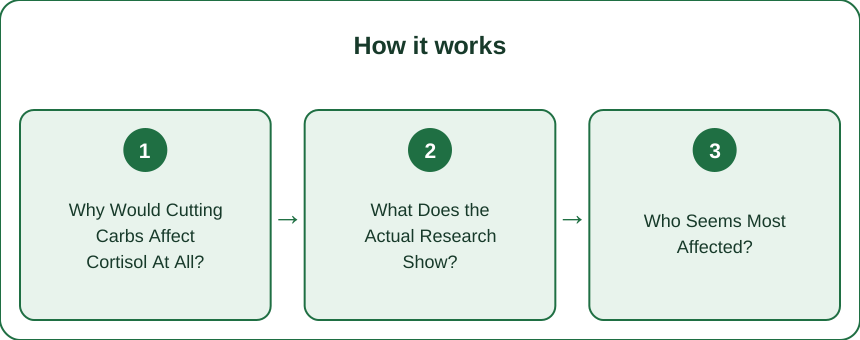
Why Would Cutting Carbs Affect Cortisol At All?
Cortisol is fundamentally a stress-response hormone, and your body doesn’t distinguish neatly between different types of stress — physical, emotional, or dietary all register through overlapping pathways in the hypothalamic-pituitary-adrenal axis. Carbohydrates are your body’s fastest, most readily available energy source, so a significant and sudden drop in carb intake can register as a mild energy-availability stressor, similar in kind (though usually smaller in magnitude) to other physical stressors like intense exercise or sleep deprivation, both of which are well-established cortisol elevators on their own.
What Does the Actual Research Show?
Some studies on very low-carb or ketogenic diets have found modestly elevated cortisol, particularly in the first 1-4 weeks of adaptation, as the body shifts its primary fuel source from glucose to fat and ketones. However, the effect size in most studies is meaningfully smaller than the dramatic framing suggests, and several studies show cortisol normalizing after the initial adaptation period as the body becomes fat- and ketone-adapted and no longer treats the reduced glucose availability as novel or threatening.
The research is genuinely mixed rather than uniformly alarming — individual variation in response is significant, and study designs vary enough (different carb thresholds, different populations, different durations) that pooling them into one simple headline number oversimplifies what’s actually a more nuanced and conditional picture.
Who Seems Most Affected?
Does exercise intensity change the picture here? Yes — the people who show the clearest cortisol response to carb restriction tend to be those combining it with other simultaneous stressors: intense or frequent exercise (particularly high-intensity or long-duration training that depends heavily on glycogen), insufficient total calorie intake, poor sleep, or high life stress independent of diet. Low-carb eating in isolation, without those compounding factors, tends to show a smaller and often temporary effect.
Does age or sex change vulnerability to this effect? Some research suggests women, particularly those who are also under-eating or over-exercising, may show a more pronounced cortisol and menstrual cycle response to aggressive carb restriction than men studied under similar conditions, though this area needs more dedicated research before drawing firm conclusions specific to sex differences.

What Nobody Tells You About This Debate
Nobody tells people that the ‘carbs vs. cortisol’ framing often skips the bigger variable entirely: total energy availability. A moderate-carb diet with insufficient total calories can raise cortisol just as much as, or more than, a well-formulated low-carb diet with adequate calories and electrolytes — carb percentage alone isn’t the whole story, and blaming carb restriction specifically often misses genuine under-eating as the real driver behind the cortisol elevation people are actually experiencing.
Myth vs Fact: Carbs and Cortisol
Myth: any amount of carb restriction, even mild, meaningfully raises cortisol. Fact: the research showing a cortisol effect is specifically about very low-carb or ketogenic-level restriction, not moderate reductions — cutting from a very high-carb baseline to a moderate one isn’t the same intervention studied in the research generating this concern.
Myth: if cortisol rises during carb restriction, it means the diet is unsafe and should be abandoned immediately. Fact: a temporary, modest adaptation-period rise that resolves within a few weeks is a different situation than a sustained elevation that persists for months — the former is a normal adjustment response, the latter is worth addressing directly with a professional rather than assuming it will resolve on its own.
How Do I Actually Tell If My Diet Is Affecting My Cortisol?
What symptoms would suggest my current approach is raising cortisol too much?
Persistent fatigue despite adequate sleep, unusual irritability, disrupted sleep quality, and new menstrual cycle irregularities are more reliable everyday indicators than trying to interpret a single cortisol lab value, which naturally fluctuates significantly through the day and isn’t a reliable single-snapshot diagnostic tool for this kind of question.
Does this mean low-carb diets are bad for everyone?
No — many people do well long-term on lower-carb approaches once past the initial adaptation period; the research suggests caution mainly for people stacking carb restriction with intense training, calorie deficits, and poor sleep simultaneously, not a blanket warning against the dietary approach itself for everyone regardless of context.
If I’m worried about cortisol, should I just avoid low-carb eating entirely?
A more useful move than avoiding it outright is often a moderate approach — adequate total calories, sufficient electrolytes, and not combining aggressive carb restriction with an aggressive training or sleep deficit at the same time, which addresses the actual compounding risk factors rather than the carb percentage in isolation.
How would I know the difference between normal keto-adaptation fatigue and an actual cortisol problem?
Typical keto-flu adaptation symptoms (mild fatigue, headache, irritability) tend to resolve within 1-2 weeks as electrolytes and fat-adaptation stabilize; symptoms that persist well beyond that window, or that worsen rather than improve, are more suggestive of an ongoing energy availability or cortisol issue worth addressing directly rather than waiting out.
Would adding electrolytes specifically help offset any cortisol-related effects of a low-carb diet?
Adequate sodium, potassium, and magnesium intake helps address one specific contributor to early low-carb fatigue (since carb restriction increases sodium excretion through the kidneys), but electrolytes address a different mechanism than cortisol itself — think of electrolyte support as removing one compounding stressor from the equation, not a direct fix for cortisol specifically.
Should I get my cortisol tested if I’m concerned about my current diet?
A single blood cortisol test is of limited use given how much cortisol naturally fluctuates through the day, but a doctor can order more informative testing (like a cortisol awakening response panel or a 4-point saliva test) if your symptoms genuinely warrant investigating further, rather than relying on a single snapshot number that’s easily misread out of context.
TL;DR:
- Very low-carb intake can modestly raise cortisol, mainly during the first 1-4 weeks of adaptation
- The effect is generally smaller than social media framing suggests, and often normalizes over time
- The people most affected are usually stacking carb restriction with under-eating, intense training, or poor sleep
- Total energy availability, not carb percentage alone, is often the bigger hidden variable
- Symptoms lasting well beyond the typical 1-2 week adaptation window deserve direct attention, not patience
The honest answer sits between ‘carbs are ruining your hormones’ and ‘diet composition doesn’t matter at all’ — context and what else is stacked on top of the carb restriction matters more than the carb number by itself.
This is general nutrition information, not personalized medical advice — a registered dietitian or doctor can help assess your specific situation.
Keep Reading
This article is for general informational purposes only and is not medical advice. Always consult a qualified health professional for guidance specific to you.