Your Questions About Cortisol and Autumn Energy Answered
Quick Answer: Cortisol follows a daily rhythm anchored to your wake time - it spikes 50-75% in the 30-45 minutes after waking and declines through the day. As sunrise gets later in autumn, that anchor weakens and the rhythm can flatten, which shows up as sluggish mornings and wired evenings. Most of what gets sold as a cortisol problem is a circadian timing problem, and morning light and consistent wake times address it better than any supplement.
Cortisol is the most misunderstood hormone in wellness marketing. It is not a stress toxin, and having it is not a problem - what matters is the shape of its daily curve.

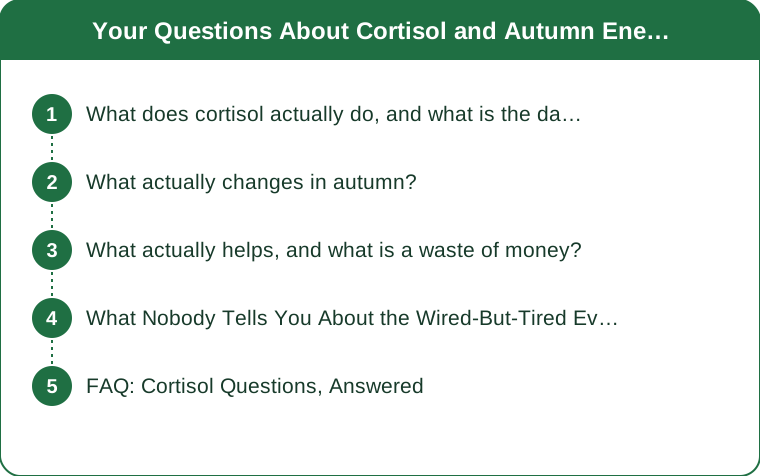
What does cortisol actually do, and what is the daily pattern?
It is a metabolic and alertness hormone with a strong daily rhythm, not simply a stress chemical.
Its actual jobs
Cortisol mobilizes glucose, regulates metabolism, modulates immune function, influences blood pressure, and - most relevant here - drives morning alertness. You need it. People with insufficient cortisol are profoundly unwell.
The normal daily curve
Cortisol is at its lowest around midnight, begins rising in the early hours, and produces a sharp spike in the 30-45 minutes after waking - the cortisol awakening response, typically a 50-75% increase over the pre-waking level. It then declines steadily through the day, with small bumps around meals and activity, reaching its trough in the evening.
Why the shape matters more than the amount
A healthy pattern is a steep morning rise and a clear evening decline. Problems associated with cortisol are usually about a flattened curve - a blunted morning rise leaving you groggy, or an insufficient evening decline leaving you wired at bedtime. Both can occur with total daily output that is entirely normal.
What the awakening response is anchored to
Your wake time and your light exposure. It is not anchored to the clock, which is why an irregular schedule flattens it and why it is vulnerable to exactly the thing autumn does to mornings.
What actually changes in autumn?
Three things, all connected to light and none of them mysterious.
The morning light signal weakens
As sunrise retreats, more people wake before it. Indoor light at 100-500 lux is a fraction of even an overcast morning outdoors at 1,000-10,000 lux. Light is a primary input to the circadian system that shapes the cortisol curve, so a weaker morning signal tends to produce a blunter awakening response.
Wake times drift
Darker mornings make it harder to get up, so people hit snooze, wake at variable times, and sleep in on weekends. Since the awakening response is anchored to when you wake, an irregular wake time means an irregular cortisol rhythm.
Evening light stays constant
Artificial evening light does not change with the season, so the evening portion of the curve keeps getting the same delay signal while the morning portion weakens. The net result is a flatter curve - less differentiation between morning and evening.
What that feels like
Sluggish, heavy mornings that take a long time to shake off. An energy dip in the afternoon. Then a second wind in the late evening when you would rather be winding down. That specific pattern is common from late September onward and it is more often a light-timing problem than a stress problem.
What does not change
There is no evidence that autumn raises baseline cortisol in any way that requires intervention. If your stress levels rise in autumn - and for many people they genuinely do, with school and work cycles restarting - that is a stress issue with a real cause, not a seasonal hormone effect.

What actually helps, and what is a waste of money?
The effective interventions are unglamorous and mostly free.
What helps, in order of effect
Morning light within an hour of waking. 10-30 minutes outdoors. This is the strongest available lever on the cortisol curve because it is the strongest available lever on circadian timing generally.
A consistent wake time. Within about 30-60 minutes, seven days a week. The awakening response is anchored to waking, so a stable wake time is what gives it something to anchor to.
Dimming evening light. The last two hours before bed. You are trying to create a large contrast between a bright morning and a dim evening.
Regular exercise, timed sensibly. Exercise acutely raises cortisol - which is normal and beneficial - and improves rhythm over time. Intense training very late in the evening can interfere with the evening decline for some people, so if you are wired after night sessions, shifting them earlier is worth testing.
Actual stress reduction. Chronic stress genuinely affects the cortisol curve. This is worth addressing directly rather than supplementing around.
What is oversold
Cortisol blockers and adrenal support supplements. Adrenal fatigue is not a recognized medical diagnosis, and a systematic review found no consistent evidence supporting it. Products aimed at it are treating a condition that has not been established.
Saliva cortisol test kits sold direct to consumers. Cortisol varies enormously by time of day, recent activity, and stress in the previous hour. A few spot samples are difficult to interpret without clinical context and frequently generate anxiety rather than information.
Adaptogens. Some, such as ashwagandha, have preliminary evidence for perceived stress and sleep. The evidence is genuinely mixed and the effects modest, and they are not a substitute for the light and schedule fundamentals. Anyone on medication or with a thyroid condition should check before using them - this is general information, not medical advice.
What Nobody Tells You About the Wired-But-Tired Evening
The 9pm second wind that everybody describes has a specific mechanism, and understanding it changes what you do about it.
There is a genuine wake-maintenance zone. In the few hours before your natural sleep onset, your circadian system actively promotes alertness - it is a countermeasure to the accumulating sleep pressure that has been building all day. This is a normal feature, not a malfunction. It is why the easiest time to fall asleep is not the hour before your usual bedtime.
Autumn makes it more pronounced. As your clock drifts later from weakened morning light, the wake-maintenance zone moves later too - so it now sits at 9 or 10pm when it used to sit at 8. You experience an early evening slump when it gets dark, push through it under bright indoor lights, and then hit a second wind exactly when you wanted to sleep.
The intervention is at the wrong end of the day from where it feels like. People try to fix wired evenings in the evening - with supplements, teas, and routines. Some of that helps at the margin. The actual lever is the morning, because that is what determines where the whole curve sits.
One evening thing genuinely does help: don’t fight the early dip with light. When you feel the 8pm slump and turn on every light in the house to push through, you deliver a delay signal at exactly the wrong time and sharpen the later second wind. Dimming instead - lamps, lower screens - lets the dip flow into actual sleepiness.
And do not go to bed early to compensate. Lying awake for an hour teaches your brain that bed is a place for being awake, which is the foundation of most persistent insomnia. Go to bed sleepy, and fix the timing from the morning end.
FAQ: Cortisol Questions, Answered
Should I get my cortisol tested?
If you have symptoms suggesting a genuine endocrine disorder - unexplained significant weight change, muscle weakness, very high or low blood pressure, unusual skin changes, profound persistent fatigue - then yes, through a clinician, who will use properly timed and interpreted testing. For ordinary tiredness and afternoon slumps, consumer cortisol kits are unlikely to give you actionable information. This is general information, not medical advice.
Does coffee mess up my cortisol curve?
Caffeine acutely raises cortisol, and the effect is blunted in habitual consumers. The advice to delay morning coffee by 90 minutes to avoid blunting your awakening response is widely repeated and rests on limited evidence. What is much better established is caffeine’s effect on sleep - its half-life is roughly 5-6 hours, so an afternoon coffee measurably affects sleep quality that night, and poor sleep affects the next day’s cortisol rhythm. If you change one thing about coffee, make it the cutoff time rather than the start time.
Is a flat cortisol curve something I need to worry about?
A flattened diurnal pattern has been associated with various health outcomes in research, but the direction of causation is not established and the measurements involved are far more rigorous than anything available at home. The practical takeaway is not to worry about your curve as a diagnosis, but to do the things that support a healthy rhythm - consistent wake time, morning light, dim evenings, adequate sleep - all of which are good ideas regardless.
TL;DR:
- Cortisol spikes 50-75% in the 30-45 minutes after waking and declines through the day; the shape matters more than the amount.
- Autumn weakens the morning light anchor while evening artificial light stays constant, flattening the curve.
- The effective levers are morning light, a consistent wake time, dim evenings, and real stress reduction - not supplements.
- Adrenal fatigue is not a recognized diagnosis, and consumer saliva kits rarely produce actionable information.
Almost everything sold as a cortisol fix is aimed at a hormone level that is probably fine. What actually shifted this month is the timing signal your body uses to shape the curve - and that gets rebuilt outdoors in the first hour after you wake up, on the same schedule every day, for about the price of putting your shoes on. This is general information, not medical advice.
Keep Reading
This article is for general informational purposes only and is not medical advice. Always consult a qualified health professional for guidance specific to you.